Home

Showing posts with label Mosques. Show all posts

Tuesday, January 14, 2014

Barakah Madinah - Madinah Al Munawarah, Saudi Arabia


We arrived in Jeddah at about Maghrib and we were heading to the holy city of Madinah. There are about 40 of us and the group  encompasses adults of all ages. Though I prayed for easy and facilitated journey, never do I expect one with no hiccups at all. I imagined, a spiritual pilgrimage is like a plate of food embellish with the mix of spice and a splash of tastes. This is my second visit to Madinah, the city of the prophet and I really can't wait the excitement and warmth of the ambience.  The people of Madinah is well known for their warm, kind and gentle characters.  After a long commotion in Jeddah when the passports of a couple in our group were taken by a stranger, we finally got onto our bus to Madinah. 

Feeling comfortable, I recollect my memories more than ten years ago, when I was in this blessed city.  I still remember while rambling alone in the souk, the shop keepers would call me to give dates and nuts. Fearing and remembering not to take any gifts from strangers I shook my head with hesitant.  The shopkeeper kept calling me "Siti Rahmah" and waving his hand rigorously towards me but realizing that I was seriously refusing his gift, he shouted "Barakah Madinah...barakah Madinah" and automatically I walked towards him, extending both my hands for him to drop the nuts and dates. He was smiling cheerfully and saying some words in Arabic. Who would in their sane state of mind to refuse the barakah of Madinah (the blessings of Madinah). Those are among the memories of Madinah I cherish forever.  

In the darkness of night, suddenly I was awoken by the heat wave in the bus and I realized we were in the middle of no where and our bus had broken down. Everybody got off the bus and we were told that a new bus will be coming in a few hours. We walked around and found a small mosque not far from the place and alhamdulilah we could pray, stretch our feet, and nap while waiting for the replacement bus. After about three hours the new bus came and again we were heading to Madinah.

We arrived Madinah in the early morning and amazingly, Madinah has changed so much since the last time I was here...huge hotels filled the city and we were lucky to be housed in Bahaudin Hotel, about 50 meters from the mosque's gate. Not only the city has changed tremendously but the souks not far from the mosque has disappeared and now the rows of shops are neatly organized in the buildings.   

The next four days we were busy moving from the hotel to the mosque.  The first day,I entered the prophet's mosque, my heart was throbbing, will I be granted the honor to enter the Raudah. The waiting was intense as the path to Raudah was opened to the public. Things can be easy or difficult depending what is destined for you but putting your best effort to enter this sacred place remains the wish of everyone who visits Madinah.  My teacher used to say "walk consciously and watch every steps you take in Madinah as you are walking in the footsteps of the prophet." Remembering those words, my feelings are overwhelmed with tears and joys!  Ya Nabi salam alaika...


Tuesday, November 26, 2013

Baiturrahman wa Baiturrahim - Banda Aceh, Sumatera, Indonesia

Baiturahman Mosque entrance from rear
Baiturahman at night
BAITURRAHMAN
Baiturahman is the biggest mosque in Banda Aceh and amazingly, this mosque built in 1612 and some claimed 1292 has survived through several calamities including the massive 2004 tsunami with only minor damages. During the Dutch invasion in 1873, the original mosque was razed to the ground and in 1877 the East Indies Governor General extended an olive branch when he offered to rebuild the grand mosque.  Designed by an Italian architect in the North Indian Moghul style, the mosque was finally completed in 1883 and not surprisingly, many Acehnese hesitated to pray at Baiturahman - most likely to show retaliation towards their conqueror. 


Today, this mosque is a dominant landmark in Banda Aceh and in 2004, when the town was struck by the tsunami, many locals took refuge in the mosque.  This mosque has survived from several quakes and even after the tsunami, it suffered very mild damage.  Almost every nights of our stay in Banda Aceh, we were here, assimilating ourselves with the locals and some did realize that we're not one of them. In Ramadhan, every night, they have talks delivered by the local scholars and most of the time the 2004 tsunami is reflected in their sermons and the people are reminded of a bigger calamity is yet to come. When I glanced through the crowd around me, I once again imagined...these people must be in their teens and twenties in 2004.

In Ramadhan, the mosque is filled with the locals 


Terawih in the women's hall
There are many pillars in the mosque
Everybody dispersed after the prayer
Taking a rest after terawih prayer
The beautiful exterior of the mosque is clearly visible even at night
This picture is taken from Medan Hotel, Aceh


BAITURRAHIM
Completely refurbished 


Baiturrahim is an old mosque of  Ulee Lheue in the settlements of coastal Aceh which were largely destroyed by the mega earthquake which unleashed the 2004 tsunami. A port town, Ulee Lheue was completely swept away by the tsunami and only a portion of the Baiturrahim Mosque was spared. Due to its close location to the sea, this mosque was seriously damaged during the tsunami.  Today, the mosque is completely renovated and like Baiturrahman, this mosque has its historical importance among the locals. The Dutch burned the mosque in 1873 and since then the mosque has undergone several rehabilitation phases to accommodate the increasing members of its community.  

In 1981, this mosque received aids from the Saudi government to enlarge its capacity; from a mosque which could hold prayers for 500 people, it was renovated to accommodate more than 1,000 people. But two years after its completion, earthquake struck Banda Aceh and the mosque's structure survived with severe damages to its roof.  Floods, earthquakes and the unprecedented tsunami has battered this mosque but still today it stands tall to serve the community of Ulee Lheue. We spent some times observing the mosque's interior and exterior and wondered what's next for Baiturrahim!
The interior of the mosque
The white wash exterior gives the mosque a fresh look after the tsunami

Visitors from other parts of Indonesia taking a break


Saturday, June 15, 2013

Pinkish Putra Mosque - Putrajaya, Malaysia

Putra Mosque - a floating view from the lake
Putrajaya is relatively a new town in Malaysia and along with other unique buildings, the  Putra Mosque began construction in Jun 1997.  It took 2 years to complete the mosque which cost approximately USD 81 million.  Its architecture has the influence of Moorish and Persian design. Non-Muslims are allowed to visit the mosque on condition that they must be properly covered and robes are provided if necessary. There is a small gallery where visitors can view the interior and take pictures.   
Putra Mosque and Prime Minister Office (the green dome) from a distance

The mosque is named after the first Prime Minister of Malaysia, the late Tunku Abdul Rahman Putra Al Hajj. Upon completion on 1st. September, 1999 this principal mosque of Putrajaya has constantly been receiving visitors from all over the world. 


Today, this 1.37 hector site of Putra Mosque is the most popular place of worship visited by the locals and foreign tourists.  The view from the lake while cruising is just simply amazing as part of the mosque is encircled by the lake.    During school holidays and weekends the area is packed with tourist buses and vans.  It takes about 45 minutes from Kuala Lumpur to Putrajaya but it is closer from Kuala Lumpur International Airport (KLIA). 
The dusky pink interior of Putra Mosque
Visitors to Putra Mosque clad in blue robes
The pink dome dominates Putrajaya landscape

Saturday, June 1, 2013

The Impressive Madrasa Bou Inania - Fez, Morocco

The interior of Madrasa Bou Inania
As a center of learning, Madrasa is an important institution in the medieval Islamic world and even today the institutions continue their challenging roles in a modern world. The fundamental role played by the Madrasa had resulted in the existence of highly literate society during the period. The name, Madrasa Bou Inania in Fez came from the founder, Abu Inan Faris (1351-1356). This Madrasa functions as a mosque and a learning center which is very much the same as Al Qarawiyin which is at another end of the Medina. They were having Asar congregational prayers when we arrived, and our guide joined the jemaah while we went to the ladies prayer room.  Certain parts of the Madrasa is under conservation work and if you look closely, the building is in need of maintenance. Khalid explained to us that the mosque had gone through a major renovation in the 18th century and was again reconstructed in the 20th century.  Madrasa Bou Inania is an example of the Marinid architecture.  The zellij tiles on the wall of the madrasa is predominantly green, the color associated with the city of Fez. We visited Molay Idris, Qarawiyin and Madrasa Bou Inania completed our mission in Fez. 

All along since the city was founded in 789 by Moulay Idris, Fez has never ceased to be a center of learning. There are other Madrasa in Fez that are worth visiting but due to time constraint, we are not able to do so. Other old Madrasa are the Madrasa of Saffarin, Madrasa of Attarin and the elegant Madrasa of Sharratin. Not far from Madrasa Bou Inania is the house of the famous Tunisian historian, Ibnu Khaldun who used to live in Fez and worked for Abu Inan. Kalid our guide showed us the door of once Ibnu Khaldun's house. Automatically, Al-Muqadimah, the seminal work of Ibnu Khaldun came to mind. It is amazing to be in Fez. It feels like you are walking on the footsteps of great scholars and thinkers of the past.
Every corners of the Madrasa is equally impressive
The door of  once the house of Ibnu Khaldun

The wood engravings are deteriorating
A combination of zellij mosaics and stucco work
Closer view of the wood design
Carving on the wooden Mashrabiya
Pillar of the Madrasa with intricate carvings
The male prayer hall
Zellij work adorns the walls of the Madrasa
This Madrasa gives accessibility to non-Muslims visitors
Entrance to the lady hall

Sunday, January 6, 2013

The Grande Mosquée de Paris - Paris, France

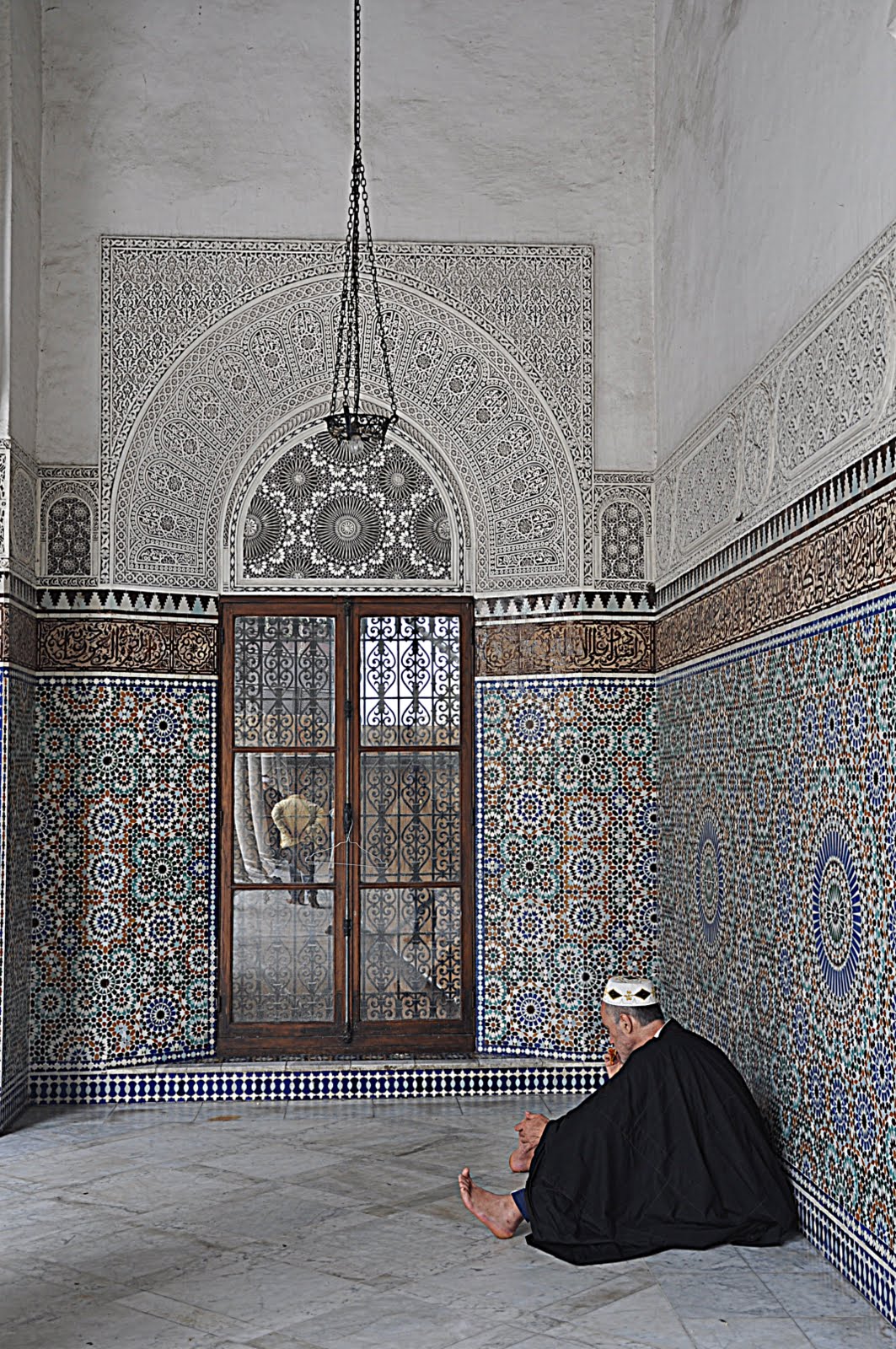
The tile work on the walls of Paris Mosque
Grand Mosque of Paris is the largest mosque in France. The minaret of the mosque is 33 meters high and the architecture imitates the Moorish of Andalusian (Mudejar). Founded in 1926, the first communal prayer was led by the Algerian Sufi (Shadilliya), Sheikh Ahmad al-Alawi on July 15, 1926. When France was occupied by the Germans in the World War II, the mosque was a secret refuge for the Jews, providing shelter and fake Muslim birth certificates to escape the holocaust (http://en.wikipedia.org/wiki/Paris_Mosque). 

A major renovation on the interior of the mosque was completed in 1992 and the decoration used mosaics, wood carvings and wrought iron imported from Morocco. What is more interesting is the central courtyard of the mosque which reminds me of the typical patios in the Andalusian homes and palaces. The ground paved with turquoise tiles and decorated with small trees, shrubs, flowers,  ponds and fountains makes the place so delightful with its refreshing look.  
One of the entrance of the mosque

Today the mosque is the center of attraction for most people especially Muslims who come to Paris and a busy place on Fridays, Ramadan and holy days. There is a Muslim Restaurant adjoining the courtyard of the mosque which opens daily from noon to 3 pm and from 7 to 10:30pm

It is located in 5th arrondissement and if you are from the Eiffel Tower, take the metro from Bir Hakim Metro station. Take line Nation to Place D'Italie and transfer to Metro line 7 with direction towards La Courneuve.  Get off at Place Monge station and you're in the precinct of the mosque. 

Information:
http://www.mosquee-de-paris.org/
Address: 2 bis Place du Puits de l'Ermite, 75005 Paris, France
Telephone: 01 45 35 97 33
The tile work on the walls
The columns and the center fountain imitates Al-Hambra of Granada
The corridors to the prayer hall
Wood carving on the door
Inscription on the walls
The central courtyard of the mosque
Moroccan style minaret
Taking a rest after the prayer