Home

Showing posts with label Architecture. Show all posts

Saturday, June 15, 2013

Pinkish Putra Mosque - Putrajaya, Malaysia

Putra Mosque - a floating view from the lake
Putrajaya is relatively a new town in Malaysia and along with other unique buildings, the  Putra Mosque began construction in Jun 1997.  It took 2 years to complete the mosque which cost approximately USD 81 million.  Its architecture has the influence of Moorish and Persian design. Non-Muslims are allowed to visit the mosque on condition that they must be properly covered and robes are provided if necessary. There is a small gallery where visitors can view the interior and take pictures.   
Putra Mosque and Prime Minister Office (the green dome) from a distance

The mosque is named after the first Prime Minister of Malaysia, the late Tunku Abdul Rahman Putra Al Hajj. Upon completion on 1st. September, 1999 this principal mosque of Putrajaya has constantly been receiving visitors from all over the world. 


Today, this 1.37 hector site of Putra Mosque is the most popular place of worship visited by the locals and foreign tourists.  The view from the lake while cruising is just simply amazing as part of the mosque is encircled by the lake.    During school holidays and weekends the area is packed with tourist buses and vans.  It takes about 45 minutes from Kuala Lumpur to Putrajaya but it is closer from Kuala Lumpur International Airport (KLIA). 
The dusky pink interior of Putra Mosque
Visitors to Putra Mosque clad in blue robes
The pink dome dominates Putrajaya landscape

Stunning Architecture and Great History - Roma, Italy

The Grand Amphitheater, Colosseum, looks so imposing in the middle of city traffics


We took the fast train from Naples to Rome in the early morning and arrived in Rome at about 10 am. There are so much to see in Rome but unfortunately we are spending only a night. However, with efficient time management, it wasn't really that bad...we got to see some of the iconic things in Rome and no shopping.  Most of the historical places are within walking distance, and the city train and buses are well connected to these interesting places. We bought a day pass, which is usable on the bus and train.

Rome's historic center was inscribed as the UNESCO World Heritage Site in 1980 which encompasses among others the well known Colosseum, Roman Forum, Roman Bath, Vatican and the ancient market.

It is a wonderful city minus the rampant pickpockets which happen almost so casually in any crowded places, the subways and even in the churches. Despite of taking all the necessary precautions,and trying to be extra careful, one of us was pickpocket in the metro. When the train is packed with people and that is just about the right time for them to get in action. How else should we remind ourselves repeatedly, be extra careful!
Trevi Fountain - one of the busiest spot in Rome


Arches of the Colosseum

A street artist painting the Coliseum
'Modern art' on Roma city metro
The graffiti on the train looks cool :)
On guard at the Vatican

Vatican - the world's smallest sovereign state


Saturday, June 1, 2013

The Impressive Madrasa Bou Inania - Fez, Morocco

The interior of Madrasa Bou Inania
As a center of learning, Madrasa is an important institution in the medieval Islamic world and even today the institutions continue their challenging roles in a modern world. The fundamental role played by the Madrasa had resulted in the existence of highly literate society during the period. The name, Madrasa Bou Inania in Fez came from the founder, Abu Inan Faris (1351-1356). This Madrasa functions as a mosque and a learning center which is very much the same as Al Qarawiyin which is at another end of the Medina. They were having Asar congregational prayers when we arrived, and our guide joined the jemaah while we went to the ladies prayer room.  Certain parts of the Madrasa is under conservation work and if you look closely, the building is in need of maintenance. Khalid explained to us that the mosque had gone through a major renovation in the 18th century and was again reconstructed in the 20th century.  Madrasa Bou Inania is an example of the Marinid architecture.  The zellij tiles on the wall of the madrasa is predominantly green, the color associated with the city of Fez. We visited Molay Idris, Qarawiyin and Madrasa Bou Inania completed our mission in Fez. 

All along since the city was founded in 789 by Moulay Idris, Fez has never ceased to be a center of learning. There are other Madrasa in Fez that are worth visiting but due to time constraint, we are not able to do so. Other old Madrasa are the Madrasa of Saffarin, Madrasa of Attarin and the elegant Madrasa of Sharratin. Not far from Madrasa Bou Inania is the house of the famous Tunisian historian, Ibnu Khaldun who used to live in Fez and worked for Abu Inan. Kalid our guide showed us the door of once Ibnu Khaldun's house. Automatically, Al-Muqadimah, the seminal work of Ibnu Khaldun came to mind. It is amazing to be in Fez. It feels like you are walking on the footsteps of great scholars and thinkers of the past.
Every corners of the Madrasa is equally impressive
The door of  once the house of Ibnu Khaldun

The wood engravings are deteriorating
A combination of zellij mosaics and stucco work
Closer view of the wood design
Carving on the wooden Mashrabiya
Pillar of the Madrasa with intricate carvings
The male prayer hall
Zellij work adorns the walls of the Madrasa
This Madrasa gives accessibility to non-Muslims visitors
Entrance to the lady hall

Sunday, January 6, 2013

The Grande Mosquée de Paris - Paris, France

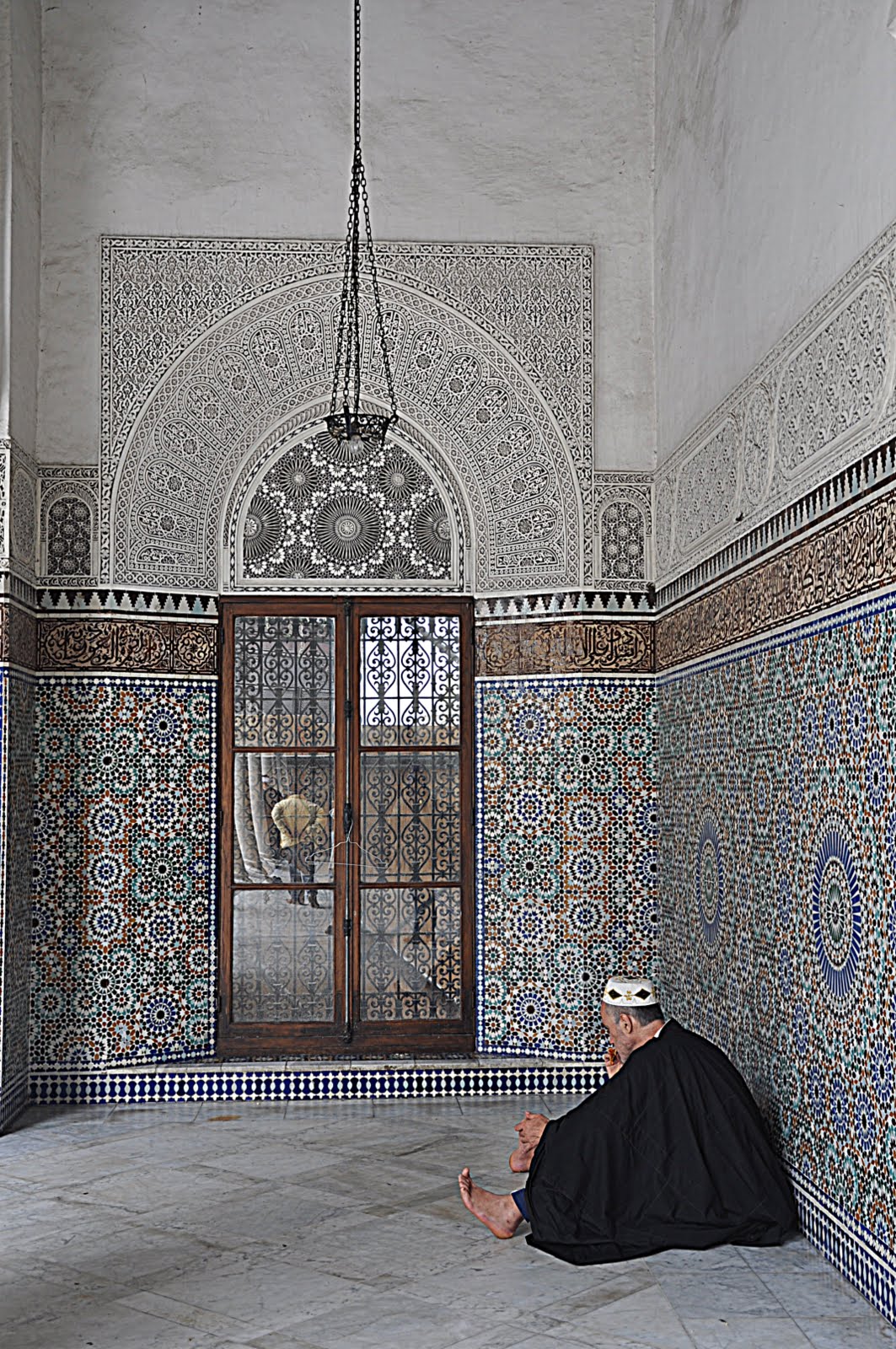
The tile work on the walls of Paris Mosque
Grand Mosque of Paris is the largest mosque in France. The minaret of the mosque is 33 meters high and the architecture imitates the Moorish of Andalusian (Mudejar). Founded in 1926, the first communal prayer was led by the Algerian Sufi (Shadilliya), Sheikh Ahmad al-Alawi on July 15, 1926. When France was occupied by the Germans in the World War II, the mosque was a secret refuge for the Jews, providing shelter and fake Muslim birth certificates to escape the holocaust (http://en.wikipedia.org/wiki/Paris_Mosque). 

A major renovation on the interior of the mosque was completed in 1992 and the decoration used mosaics, wood carvings and wrought iron imported from Morocco. What is more interesting is the central courtyard of the mosque which reminds me of the typical patios in the Andalusian homes and palaces. The ground paved with turquoise tiles and decorated with small trees, shrubs, flowers,  ponds and fountains makes the place so delightful with its refreshing look.  
One of the entrance of the mosque

Today the mosque is the center of attraction for most people especially Muslims who come to Paris and a busy place on Fridays, Ramadan and holy days. There is a Muslim Restaurant adjoining the courtyard of the mosque which opens daily from noon to 3 pm and from 7 to 10:30pm

It is located in 5th arrondissement and if you are from the Eiffel Tower, take the metro from Bir Hakim Metro station. Take line Nation to Place D'Italie and transfer to Metro line 7 with direction towards La Courneuve.  Get off at Place Monge station and you're in the precinct of the mosque. 

Information:
http://www.mosquee-de-paris.org/
Address: 2 bis Place du Puits de l'Ermite, 75005 Paris, France
Telephone: 01 45 35 97 33
The tile work on the walls
The columns and the center fountain imitates Al-Hambra of Granada
The corridors to the prayer hall
Wood carving on the door
Inscription on the walls
The central courtyard of the mosque
Moroccan style minaret
Taking a rest after the prayer

Tuesday, December 25, 2012

The Iconic Ponte Vechio - Florence, Italy

The rustic Ponte Vechio, Florence, Italy


Florence is the main town of Tuscany region and it is in the center of Italy. The city of Florence is not too big and even without a map it is quiet easy to navigate the city. We walked from the main train station, Santa Maria Novella station to San Lorenzo Leather market and from there we walked to River Arno. 

The city has many high-end Italian designers stores, hotels  and interesting sites to visit. It is also a practical and perfect base to tour the region. If you walk along river Arno, you will see many people pointing their cameras towards an old bridge. At a glance the bridge does not look like a monument that deserves all the attentions but as I read through its history, Ponte Vechio has an interesting history to tell. A story of how it has been through a test of time and a series of destruction but today it is still there for us to appreciate it. 

It was believed that Ponte Vecchio (Old Bridge) was built during Roman times in Florence. Previously, the shops on the bridge was occupied by the butchers but today, the present tenants are jewelers, art and souvenirs sellers. The bridge was first built in 996 and reconstructed in 1117 after it was destroyed by a flood and again it was swept by flood in 1333. In 1345, the bridge was rebuilt again but during the World War II, the Germans destroyed Ponte Vechio when they retreat on August 4, 1944. 

This Florence's most famous old bridge is one of the most photographed landmark in the city and it is not surprising to see many people leaning on the walls along River Arno to get their best shots of this iconic bridge. The buildings along River Arno too are colorful and interesting to watch but due to heavy crowds around the area, you have to watch your belongings and wallets at all time.

The view along River Arno
People flooding the bridge
Souvenir shops on the bridge
The buildings at the other end of the bridge

A side view
On the bank of River Arno

The middle part of the bridge
Another view of Ponte Vechio
The private accommodation on the bridge